 CanbiZ (MickLesk)
87b9d51761
CanbiZ (MickLesk)
87b9d51761
* Teach the PocketBase bot every field

The bot covered most of script_scripts but not categories, has_arm,
execute_in or app_vars, so those had to be edited by hand in the admin UI.

categories is a relation, so names are resolved against script_categories
and ids are accepted too - a copy out of the PocketBase UI works either way.
app_vars is a JSON column and rides the code-block 'set' path with its
content parsed rather than stored verbatim, so readers get an object.

cpu/ram/hdd/os/version live inside install_methods, and '/pocketbase immich
hdd=25' is how people ask for them. They now route to the default (non-Alpine)
method instead of being rejected as unknown fields, the reply names which
method was touched, and the value syncs into ct/<slug>.sh like the 'method'
path already does.

* Add screenshots and type to the bot

Two gaps were left. type is a relation to z_ref_script_types, so it needs the
same name-to-id resolution as categories - people write "ct", not a
fifteen-character id. Screenshots had no command at all.

The screenshot subcommand hands the URLs to the frontend's /api/screenshots
rather than fetching images inside a workflow. That endpoint already checks
the content type and size and attaches the file to PocketBase; doing it a
second time here would be a second set of bugs. It needs
SCREENSHOT_IMPORT_SECRET, and says so plainly when it is missing instead of
failing halfway.

slug stays deliberately out of reach. It is the URL, the JSON filename and the
ct/<slug>.sh path at once, so renaming it is a migration rather than an edit,
and the help text now says that instead of leaving people to wonder.

Proxmox VE Helper-Scripts
One-command installations for services, containers, and VMs on Proxmox VE
A community project — built on the foundation of @tteck's original work





What is this?
Simplify your Proxmox VE setup with community-driven automation scripts.
Install and configure popular self-hosted services with a single command — no manual package hunting, no config file archaeology. Paste a command into your Proxmox shell, answer a few prompts, and your container or VM is up and running.
The collection covers hundreds of services across categories like home automation, media servers, networking tools, databases, monitoring stacks, and more.
Requirements
| Component | Details |
|---|---|
| Proxmox VE | Version 8.4, 9.0, 9.1, or 9.2 |
| Host OS | Proxmox VE (Debian-based) |
| Access | Root shell access on the Proxmox host |
| Network | Internet connection required during installation |
Getting Started
The fastest way to find and run scripts:
- Go to community-scripts.org
- Search for the service you want (e.g. "Home Assistant", "Nginx Proxy Manager", "Jellyfin")
- Copy the one-line install command from the script page
- Open your Proxmox Shell and paste it
- Choose between Default or Advanced setup and follow the prompts
Each script page documents what the container includes, default resource allocation, and post-install notes.
How Scripts Work
Every script follows the same pattern:
Default mode — Picks sensible resource defaults (CPU, RAM, storage) and asks only the minimum required questions. Most installs finish in under five minutes.
Advanced mode — Gives you full control over container settings, networking, storage backends, and application-level configuration before anything is installed.
After installation, each container ships with a post-install helper accessible from the Proxmox shell. It handles common tasks like:
- Applying updates to the installed service
- Changing application settings without manually editing config files
- Basic troubleshooting and log access
What's Included
The repository covers a wide range of categories. A few examples:
| Category | Examples |
|---|---|
| Home Automation | Home Assistant, Zigbee2MQTT, ESPHome, Node-RED |
| Media | Jellyfin, Plex, Radarr, Sonarr, Immich |
| Networking | AdGuard Home, Nginx Proxy Manager, Pi-hole, Traefik |
| Monitoring | Grafana, Prometheus, Uptime Kuma, Netdata |
| Databases | PostgreSQL, MariaDB, Redis, InfluxDB |
| Security | Vaultwarden, CrowdSec, Authentik |
| Dev & Tools | Gitea, Portainer, VS Code Server, n8n |
Browse the full list at community-scripts.org/categories — new scripts are added regularly.
Contributing
This project runs on community contributions. Whether you want to write new scripts, improve existing ones, or just report a bug — every bit helps.
Where to start
| I want to… | Go here |
|---|---|
| Add a new script | ProxmoxVED — new scripts are tested here first |
| Fix or improve an existing script | Contributing Guidelines — open a PR in this repo |
| Report a bug or broken script | Issues |
| Request a new script or feature | Discussions |
| Report a security vulnerability | Security Policy |
| Get help or chat with other users | Discord |
Before you open a PR
- New scripts go to ProxmoxVED, not here. PRs with new scripts opened directly against this repo will be closed.
- Bug fixes and improvements to existing scripts belong in this repo — read the Contributing Guidelines first.
- Keep PRs focused. One fix or feature per PR.
- Document what your script installs and any non-obvious decisions in the corresponding JSON metadata file.
Core Team
 MickLesk |
 michelroegl-brunner |
 BramSuurdje |
 CrazyWolf13 |
 tremor021 |
 vhsdream |
 asylumexp |
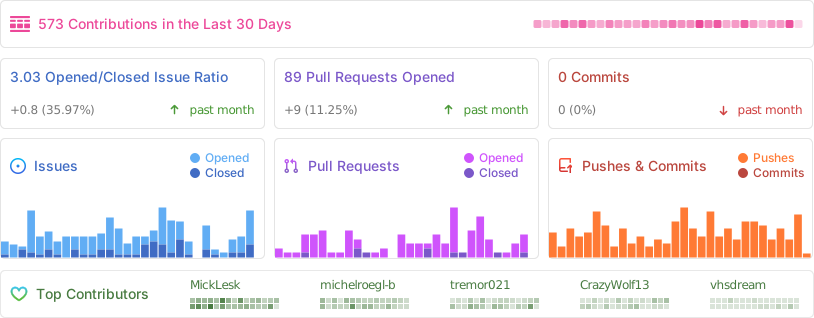
Project Activity
Support the Project
This project is maintained by volunteers. All infrastructure costs come out of pocket, and the work is done in people's spare time.
30% of all donations are forwarded directly to cancer research and hospice care — a cause that was important to tteck.


License
This project is licensed under the MIT License — free to use, modify, and redistribute for personal and commercial purposes.
See the full license text in LICENSE.
Maintained and expanded by the community · In memory of tteck
Proxmox® is a registered trademark of Proxmox Server Solutions GmbH