 baldurk
211d8532fa
baldurk
211d8532fa
* On discrete GPUs that expose PCI-E window memory (device local but still host
  visible) this memory is extremely slow to read from on the CPU. It's
  significantly faster to issue a command buffer to get the GPU to copy into CPU
  memory and wait on that command buffer to finish, then read from the copy.
* We do this for detected coherent writes in queue submit, issuing the copy on
  the queue being submitted to. We do *not* do this for memory unmaps or
  explicit application flushes. This does mean those will remain slow, however
  with no queue to use the synchronisation challenges become more significant
  and most applications leave memory persistently mapped.




RenderDoc is a frame-capture based graphics debugger, currently available for Vulkan, D3D11, D3D12, OpenGL, and OpenGL ES development on Windows 7 - 10, Linux, Android, Stadia, and Nintendo Switch™. It is completely open-source under the MIT license.
If you have any questions, suggestions or problems or you can create an issue here on github, email me directly or come into IRC or Discord to discuss it.
To install on windows run the appropriate installer for your OS (64-bit | 32-bit) or download the portable zip from the builds page. The 64-bit windows build fully supports capturing from 32-bit programs. On linux there is a binary tarball available, or your distribution may package it. If not you can build from source.
- Downloads: Stable and nightly builds: https://renderdoc.org/builds ( Symbol server )
- Documentation: HTML online, CHM in builds, Videos
- Contact: baldurk@baldurk.org, #renderdoc on freenode IRC, Discord server
- Code of Conduct: Contributor Covenant
- Information for contributors: All contribution information, Compilation instructions, Roadmap
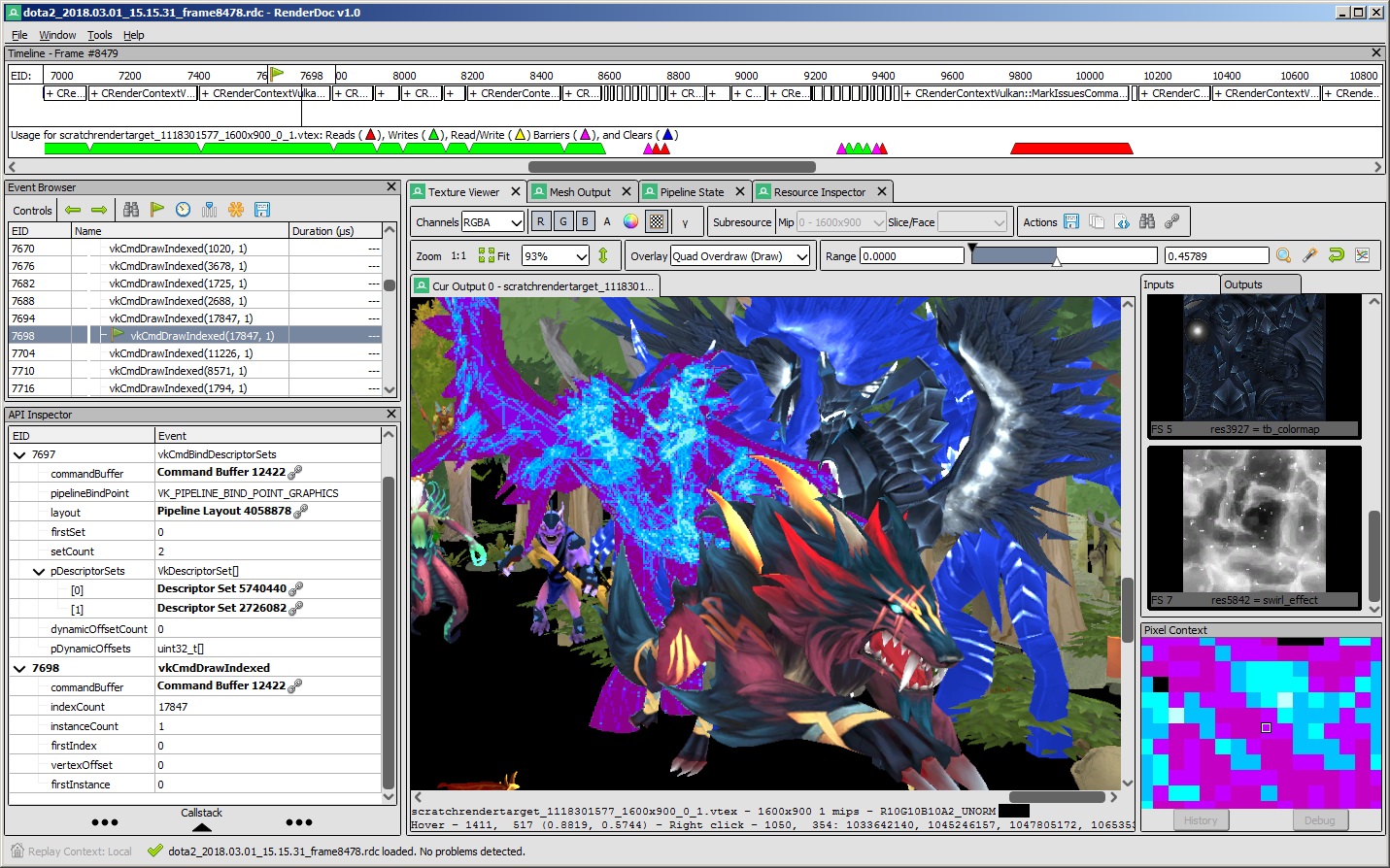
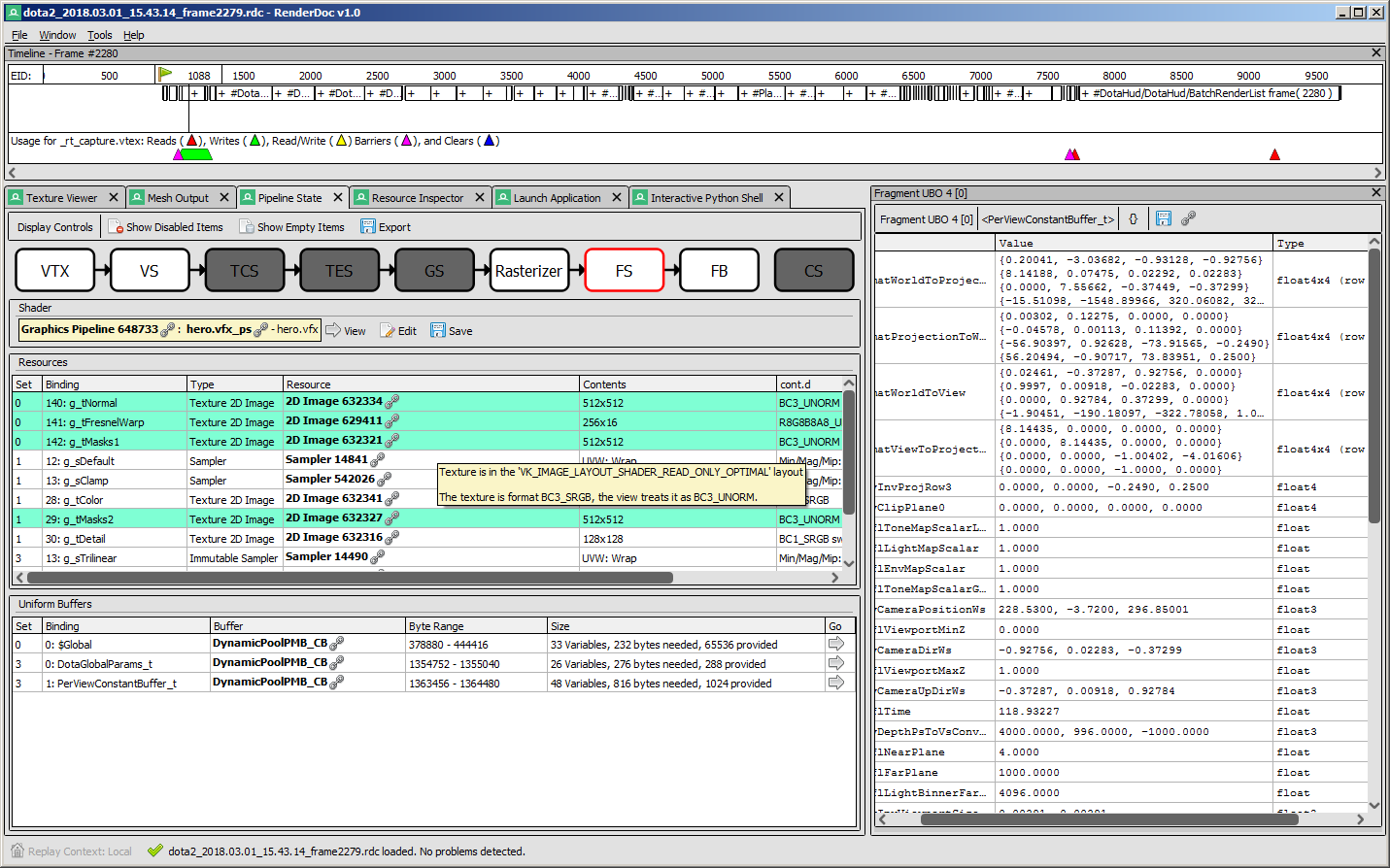
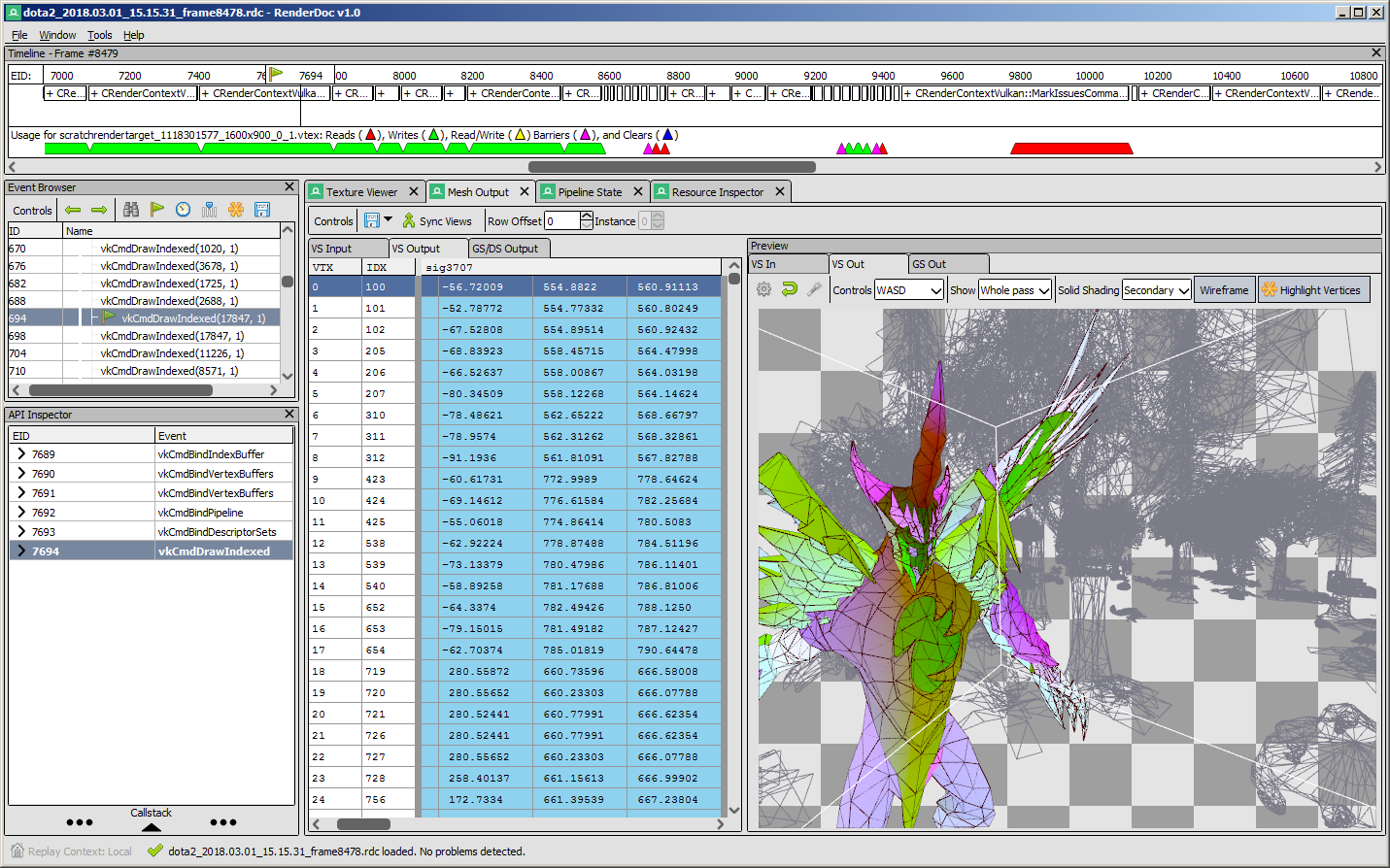
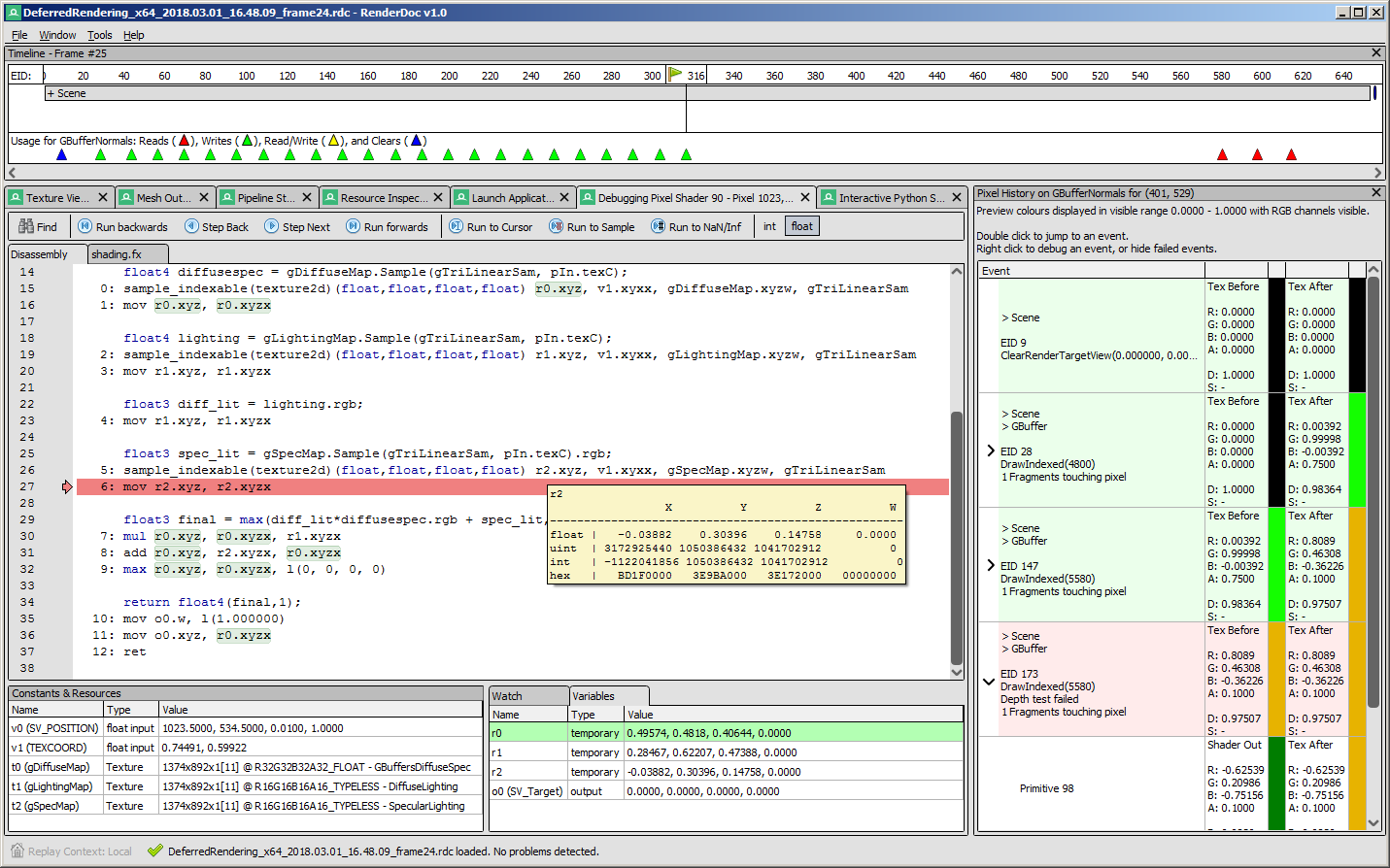
Screenshots
 |
 |
|---|---|
 |
 |
API Support
| Windows | Linux | Android | Stadia | |
|---|---|---|---|---|
| Vulkan | ✔️ | ✔️ | ✔️ | ✔️ |
| OpenGL ES 2.0 - 3.2 | ✔️ | ✔️ | ✔️ | N/A |
| OpenGL 3.2 - 4.6 Core | ✔️ | ✔️ | N/A | N/A |
| D3D11 & D3D12 | ✔️ | N/A | N/A | N/A |
| OpenGL 1.0 - 2.0 Compat | ✖️ | ✖️ | N/A | N/A |
| D3D9 & 10 | ✖️ | N/A | N/A | N/A |
| Metal | N/A | N/A | N/A | N/A |
- Nintendo Switch™ support is distributed separately for authorized developers as part of the NintendoSDK. For more information, consult the Nintendo Developer Portal.
Downloads
There are binary releases available, built from the release targets. If you just want to use the program and you ended up here, this is what you want :).
It's recommended that if you're new you start with the stable builds. Nightly builds are available every day from the v1.x branch here if you need it, but correspondingly may be less stable.
Documentation
The text documentation is available online for the latest stable version, as well as in renderdoc.chm in any build. It's built from restructured text with sphinx.
As mentioned above there are some youtube videos showing the use of some basic features and an introduction/overview.
There is also a great presentation by @Icetigris which goes into some details of how RenderDoc can be used in real world situations: slides are up here.
License
RenderDoc is released under the MIT license, see LICENSE.md for full text as well as 3rd party library acknowledgements.
Compiling
Building RenderDoc is fairly straight forward on most platforms. See Compiling.md for more details.
Contributing & Development
I've added some notes on how to contribute, as well as where to get started looking through the code in Developing-Change.md. All contribution information is available under CONTRIBUTING.md.