 RustDeskandClaude Fable 5.1
0b3a1ddd80
RustDeskandClaude Fable 5.1
0b3a1ddd80
A PunchHole needs no authentication: anyone who knows this id can ask hbbs
to have us open a punch, and each one hbbs sends is spawned without a limit.
Every punch pays per request. punch_udp_hole binds a socket of its own and
start_ipv6 another; the TCP punch opens a listener on the ephemeral port of
its own connection to hbbs, with a punch of its own in flight beside it -
`reuse` sets the socket flags, it shares no fd - and the LAN listen a
FetchLocalAddr opens is that listener again. All of them then wait up to
CONNECT_TIMEOUT for the peer, so a stream of requests holds as many sockets
as it likes for as long as it keeps sending.

Each takes a place in one of two pools of 32 - UDP over v4 and v6 in one,
the TCP punch and the LAN listen in the other - and gives it back the
moment the peer's session is up - the KCP accept, the TCP stream in hand -
or when the wait ends without one: a place stands for a socket waiting for
its peer and nothing past it, and from the session on the connection layer's
own limits apply, the same handoff the WebRTC answerer's slot makes at its
open data channel. At the limit an arrival is declined rather than an older
punch cut short, since the places turn over on their own, within
CONNECT_TIMEOUT and the few seconds the punch phases add to it, and cutting
one short would drop a socket that may be a moment from carrying a session. Two pools rather than one, so that neither
transport pays for the other's crowd: a connection costs a place in each,
the controller's preferred request punching UDP and its TCP fallback
request punching TCP, and the transports that lose the race hold theirs for
the whole wait, so one pool of 32 would be about ten connections setting up
at once and a crowd of UDP punches would decline a TCP punch that had
nothing to do with it. A place is taken only for a punch that will
be made: whether the v4 legs relay is decided first, since the relay branch
runs the whole session and a place held across it would let ordinary relay
traffic use the pool up. A declined LAN listen falls to the relay, as one
that fails for any other reason does.

Declined is the listen alone, never the reply. One PunchHoleSent carries the
WebRTC answer, the v6 address and the relay server along with the v4 punch,
and the controller sends one request for all of them and retries it three
times before it fails outright, so a reply withheld for want of a v4 place
would lose the transports that needed none. The reply goes out as before, on
a socket that then goes at once, resends and all - a declined request is not
worth a socket kept for its reply's sake, and the controller re-asks on its
own - and what the controller loses is its v4 attempt at a mapping that no
longer answers; its others go on.

A request that carries a v6 address costs two places, and the v4 one is
taken first: the v6 punch starts before the v4 one does, and taken in that
order the last place would go to the transport the peer may have no route
for and leave the one it can count on with none. A declined v6 punch leaves
the v4 path to carry the connection, as it already does wherever this
machine has no public IPv6 address. Each kind logs at most one line a
minute, carrying the number of requests it stands for, since the peer
decides how often it asks.

Tests: the places are the bound and come back on drop; a full UDP pool
leaves the TCP places alone; at the last place it
is the v6 punch that goes without; a declined UDP punch still sends its
PunchHoleSent, answer and v6 address intact, to a loopback stand-in for
hbbs; a listen whose peer never probes gives its place back.


Claude-Session: https://claude.ai/code/session_019aokqJuhjvB3kijXtAg5Ns

Co-authored-by: Claude Fable 5.1 <noreply@anthropic.com>

Build •
Docker •
Structure •
Screenshots
[Українська] | [česky] | [中文] | [Magyar] | [Español] | [فارسی] | [Français] | [Deutsch] | [Polski] | [Indonesian] | [Suomi] | [മലയാളം] | [日本語] | [Nederlands] | [Italiano] | [Русский] | [Português (Brasil)] | [Esperanto] | [한국어] | [العربي] | [Tiếng Việt] | [Dansk] | [Ελληνικά] | [Türkçe] | [Norsk] | [Română]
We need your help to translate this README, RustDesk UI and RustDesk Doc to your native language
Caution
Misuse Disclaimer:
The developers of RustDesk do not condone or support any unethical or illegal use of this software. Misuse, such as unauthorized access, control or invasion of privacy, is strictly against our guidelines. The authors are not responsible for any misuse of the application.
Chat with us: Discord | Twitter | Reddit | YouTube

Yet another remote desktop solution, written in Rust. Works out of the box with no configuration required. You have full control of your data, with no concerns about security. You can use our rendezvous/relay server, set up your own, or write your own rendezvous/relay server.
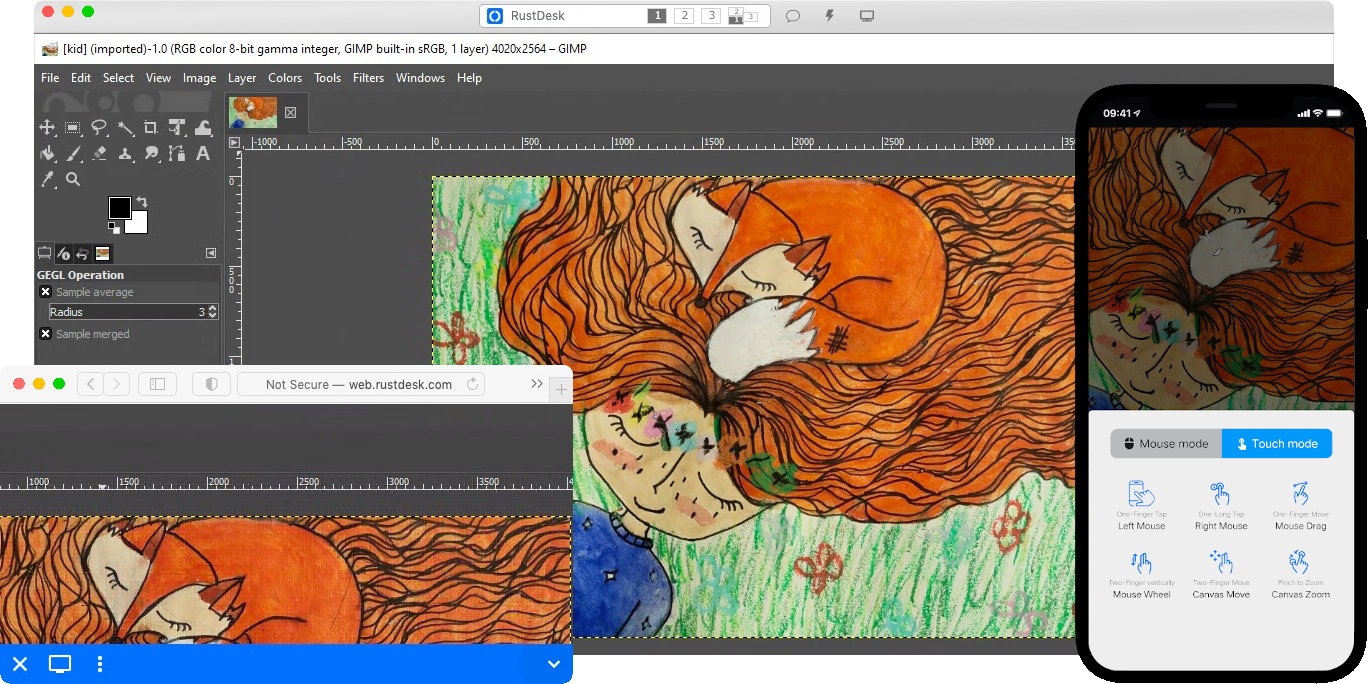
RustDesk welcomes contribution from everyone. See CONTRIBUTING.md for help getting started.

Dependencies
Desktop versions use Flutter or Sciter (deprecated) for GUI. This tutorial is for Sciter only, since it is easier and more friendly to start. Check out our CI for building the Flutter version.
Please download Sciter dynamic library yourself.
Raw Steps to build
-
Prepare your Rust development env and C++ build env
-
Install vcpkg, and set
VCPKG_ROOTenv variable correctly- Windows: vcpkg install libvpx:x64-windows-static libyuv:x64-windows-static opus:x64-windows-static aom:x64-windows-static
- Linux/macOS: vcpkg install libvpx libyuv opus aom
-
run
cargo run
Build
How to Build on Linux
Ubuntu 18 (Debian 10)
sudo apt install -y zip g++ gcc git curl wget nasm yasm libgtk-3-dev clang libxcb-randr0-dev libxdo-dev \
        libxfixes-dev libxcb-shape0-dev libxcb-xfixes0-dev libasound2-dev libpulse-dev cmake make \
        libclang-dev ninja-build libgstreamer1.0-dev libgstreamer-plugins-base1.0-dev
openSUSE Tumbleweed
sudo zypper install gcc-c++ git curl wget nasm yasm gcc gtk3-devel clang libxcb-devel libXfixes-devel cmake alsa-lib-devel gstreamer-devel gstreamer-plugins-base-devel xdotool-devel
Fedora 28 (CentOS 8)
sudo yum -y install gcc-c++ git curl wget nasm yasm gcc gtk3-devel clang libxcb-devel libxdo-devel libXfixes-devel pulseaudio-libs-devel cmake alsa-lib-devel gstreamer1-devel gstreamer1-plugins-base-devel
Arch (Manjaro)
sudo pacman -Syu --needed unzip git cmake gcc curl wget yasm nasm zip make pkg-config clang gtk3 xdotool libxcb libxfixes alsa-lib pipewire
Install vcpkg
git clone https://github.com/microsoft/vcpkg
cd vcpkg
git checkout 2023.04.15
cd ..
vcpkg/bootstrap-vcpkg.sh
export VCPKG_ROOT=$HOME/vcpkg
vcpkg/vcpkg install libvpx libyuv opus aom
Fix libvpx (For Fedora)
cd vcpkg/buildtrees/libvpx/src
cd *
./configure
sed -i 's/CFLAGS+=-I/CFLAGS+=-fPIC -I/g' Makefile
sed -i 's/CXXFLAGS+=-I/CXXFLAGS+=-fPIC -I/g' Makefile
make
cp libvpx.a $HOME/vcpkg/installed/x64-linux/lib/
cd
Build
curl --proto '=https' --tlsv1.2 -sSf https://sh.rustup.rs | sh
source $HOME/.cargo/env
git clone --recurse-submodules https://github.com/rustdesk/rustdesk
cd rustdesk
mkdir -p target/debug
wget https://raw.githubusercontent.com/c-smile/sciter-sdk/master/bin.lnx/x64/libsciter-gtk.so
mv libsciter-gtk.so target/debug
VCPKG_ROOT=$HOME/vcpkg cargo run
How to build with Docker
Begin by cloning the repository and building the Docker container:
git clone https://github.com/rustdesk/rustdesk
cd rustdesk
git submodule update --init --recursive
docker build -t "rustdesk-builder" .
Then, each time you need to build the application, run the following command:
docker run --rm -it -v $PWD:/home/user/rustdesk -v rustdesk-git-cache:/home/user/.cargo/git -v rustdesk-registry-cache:/home/user/.cargo/registry -e PUID="$(id -u)" -e PGID="$(id -g)" rustdesk-builder
Note that the first build may take longer before dependencies are cached, subsequent builds will be faster. Additionally, if you need to specify different arguments to the build command, you may do so at the end of the command in the <OPTIONAL-ARGS> position. For instance, if you wanted to build an optimized release version, you would run the command above followed by --release. The resulting executable will be available in the target folder on your system, and can be run with:
target/debug/rustdesk
Or, if you're running a release executable:
target/release/rustdesk
Please ensure that you run these commands from the root of the RustDesk repository, or the application may not find the required resources. Also note that other cargo subcommands such as install or run are not currently supported via this method as they would install or run the program inside the container instead of the host.
File Structure
- libs/hbb_common: video codec, config, tcp/udp wrapper, and some other utility functions shared with the server
- libs/base: protobuf, fs functions for file transfer, keyboard and platform code used only by this app
- libs/scrap: screen capture
- libs/enigo: platform specific keyboard/mouse control
- libs/clipboard: file copy and paste implementation for Windows, Linux, macOS.
- src/ui: obsolete Sciter UI (deprecated)
- src/server: audio/clipboard/input/video services, and network connections
- src/client.rs: start a peer connection
- src/rendezvous_mediator.rs: Communicate with rustdesk-server, wait for remote direct (TCP hole punching) or relayed connection
- src/platform: platform specific code
- flutter: Flutter code for desktop and mobile