 54416dcaa1
* fix(wayland): preserve unmatched streams and validate display offset cache

- Keep unmatched streams in `sort_streams` instead of dropping them when no
  monitor sits at `(0, 0)` (e.g. vertically offset multi-monitor layouts).
- Reject stale `wayland-pipewire-display-offset` entries whose offsets do not
  match any current display origin, skip caching unresolved `(0, 0)` defaults,
  and fall back to rotated/logical display dimensions in `try_fill_positions`.
- Replace global `HAS_POSITION_ATTR` with per-stream `has_position` and
  per-session `positions_filled` tracking.
- Do not latch `PIPEWIRE_INITIALIZED` when `init_displays` yields no displays.

Fixes https://github.com/rustdesk/rustdesk/issues/17027

Co-authored-by: Copilot <223556219+Copilot@users.noreply.github.com>

* fix(wayland): restrict fallback display matching to unique outputs

- Keep `try_fill_positions` exact physical-mode matching for multi-match
  cursor disambiguation, and apply rotated/logical-size fallback only
  when a single display matches uniquely (leaving ambiguous cases
  unchanged and uncached).
- Inline the unmatched-stream preservation directly into `sort_streams`
  without the generic `sort_by_display_order` wrapper.

Co-authored-by: Copilot <223556219+Copilot@users.noreply.github.com>

* fix(wayland): cache only resolved display offsets and drop the size fallback

- Remove `unique_fallback_origin`: a unique rotated output is already placed
  by `reconciled_origin`, and matching a stream size against `logical_size`
  could bind a region or virtual stream to a scaled output and cache it.
- Report from `fill_multi_matched_positions` whether every stream was told
  apart, and do not cache the offsets when it was not (no embedded cursor
  mode, or a probe failed).
- Require each cached offset to name a display of its own, so a cache holding
  two streams on one output is rejected; mirrored outputs still pass.
- Import `serde_json` in the test module: on Linux scrap only gets it through
  `hbb_common`.
- Leave `init_displays` as on master: once `sort_streams` keeps unmatched
  streams the display list is no longer emptied, so the empty-list check
  cannot fire, and the initialization-state change is a separate matter.

Co-Authored-By: Claude Fable 5.2 <noreply@anthropic.com>
Claude-Session: https://claude.ai/code/session_01JAxkkkfvhEPKVg85ZHovfs

* chore(wayland): drop edits unrelated to the fix

- Remove the comment left over from HAS_POSITION_ATTR.
- Restore Vec::new() in sort_streams.
- Drop the empty-token check in validate_display_offset_cache: the cache
  is never written without a token, and the token comparison already
  rejects an empty current token.

Co-Authored-By: Claude Opus 5.5 <noreply@anthropic.com>
Claude-Session: https://claude.ai/code/session_01JAxkkkfvhEPKVg85ZHovfs

* fix(wayland): narrow the #17027 fix to sort_streams

Revert the offset-cache, position-flag and disambiguation changes from
the earlier commits; only sort_streams changes now.

- sort_streams keeps a stream whose position names no display (the KDE
  full-workspace stream at (0, 0) in #17027) and, as on master, still
  drops a stream at an origin another stream already took. Keeping that
  one too let a same-size stream left at another display's origin send
  pointer input to that display.
- With the stream kept, the stale [[0, 0]] offset cache and the global
  HAS_POSITION_ATTR no longer break #17027: a cached (0, 0) gives the
  position recomputing would. Both stay as on master.
- The offset cache test goes with the validation it covered.
  sort_streams takes PipeWireCapturable, which holds a D-Bus connection
  and a fd, so it has no unit test.

Co-Authored-By: Claude Opus 5.5 <noreply@anthropic.com>
Claude-Session: https://claude.ai/code/session_01JAxkkkfvhEPKVg85ZHovfs

---------

Co-authored-by: Copilot <223556219+Copilot@users.noreply.github.com>
Co-authored-by: Claude Fable 5.2 <noreply@anthropic.com>

Build •
Docker •
Structure •
Screenshots
[Українська] | [česky] | [中文] | [Magyar] | [Español] | [فارسی] | [Français] | [Deutsch] | [Polski] | [Indonesian] | [Suomi] | [മലയാളം] | [日本語] | [Nederlands] | [Italiano] | [Русский] | [Português (Portugal)] | [Português (Brasil)] | [Esperanto] | [한국어] | [العربي] | [Tiếng Việt] | [Dansk] | [Ελληνικά] | [Türkçe] | [Norsk] | [Română] | [ქართული]
We need your help to translate this README, RustDesk UI and RustDesk Doc to your native language
Caution
Misuse Disclaimer:
The developers of RustDesk do not condone or support any unethical or illegal use of this software. Misuse, such as unauthorized access, control or invasion of privacy, is strictly against our guidelines. The authors are not responsible for any misuse of the application.
Chat with us: Discord | Twitter | Reddit | YouTube

Yet another remote desktop solution, written in Rust. Works out of the box with no configuration required. You have full control of your data, with no concerns about security. You can use our rendezvous/relay server, set up your own, or write your own rendezvous/relay server.
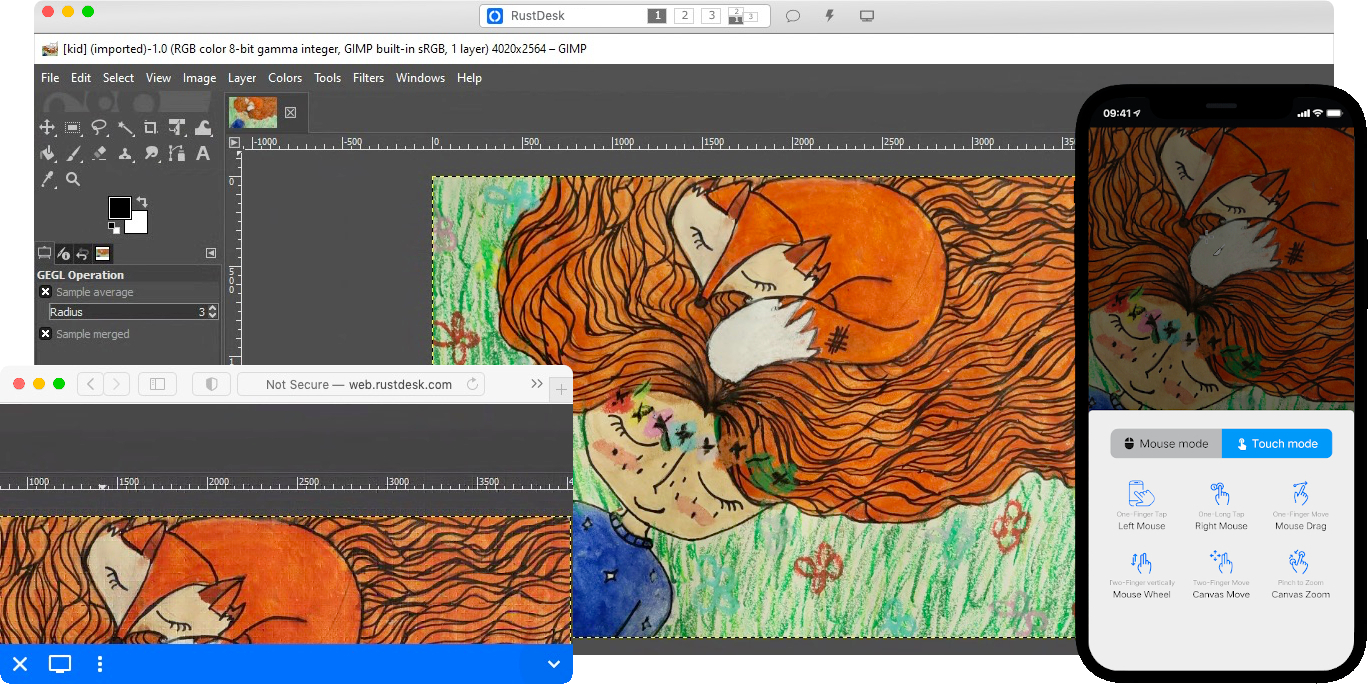
RustDesk welcomes contribution from everyone. See CONTRIBUTING.md for help getting started.

Dependencies
Desktop versions use Flutter or Sciter (deprecated) for GUI. This tutorial is for Sciter only, since it is easier and more friendly to start. Check out our CI for building the Flutter version.
Please download Sciter dynamic library yourself.
Raw Steps to build
-
Prepare your Rust development env and C++ build env
-
Install vcpkg, and set
VCPKG_ROOTenv variable correctly- Windows: vcpkg install libvpx:x64-windows-static libyuv:x64-windows-static opus:x64-windows-static aom:x64-windows-static
- Linux/macOS: vcpkg install libvpx libyuv opus aom
-
run
cargo run
Build
How to Build on Linux
Ubuntu 18 (Debian 10)
sudo apt install -y zip g++ gcc git curl wget nasm yasm libgtk-3-dev clang libxcb-randr0-dev libxdo-dev \
        libxfixes-dev libxcb-shape0-dev libxcb-xfixes0-dev libasound2-dev libpulse-dev cmake make \
        libclang-dev ninja-build libgstreamer1.0-dev libgstreamer-plugins-base1.0-dev
openSUSE Tumbleweed
sudo zypper install gcc-c++ git curl wget nasm yasm gcc gtk3-devel clang libxcb-devel libXfixes-devel cmake alsa-lib-devel gstreamer-devel gstreamer-plugins-base-devel xdotool-devel
Fedora 28 (CentOS 8)
sudo yum -y install gcc-c++ git curl wget nasm yasm gcc gtk3-devel clang libxcb-devel libxdo-devel libXfixes-devel pulseaudio-libs-devel cmake alsa-lib-devel gstreamer1-devel gstreamer1-plugins-base-devel
Arch (Manjaro)
sudo pacman -Syu --needed unzip git cmake gcc curl wget yasm nasm zip make pkg-config clang gtk3 xdotool libxcb libxfixes alsa-lib pipewire
Install vcpkg
git clone https://github.com/microsoft/vcpkg
cd vcpkg
git checkout 2023.04.15
cd ..
vcpkg/bootstrap-vcpkg.sh
export VCPKG_ROOT=$HOME/vcpkg
vcpkg/vcpkg install libvpx libyuv opus aom
Fix libvpx (For Fedora)
cd vcpkg/buildtrees/libvpx/src
cd *
./configure
sed -i 's/CFLAGS+=-I/CFLAGS+=-fPIC -I/g' Makefile
sed -i 's/CXXFLAGS+=-I/CXXFLAGS+=-fPIC -I/g' Makefile
make
cp libvpx.a $HOME/vcpkg/installed/x64-linux/lib/
cd
Build
curl --proto '=https' --tlsv1.2 -sSf https://sh.rustup.rs | sh
source $HOME/.cargo/env
git clone --recurse-submodules https://github.com/rustdesk/rustdesk
cd rustdesk
mkdir -p target/debug
wget https://raw.githubusercontent.com/c-smile/sciter-sdk/master/bin.lnx/x64/libsciter-gtk.so
mv libsciter-gtk.so target/debug
VCPKG_ROOT=$HOME/vcpkg cargo run
How to build with Docker
Begin by cloning the repository and building the Docker container:
git clone https://github.com/rustdesk/rustdesk
cd rustdesk
git submodule update --init --recursive
docker build -t "rustdesk-builder" .
Then, each time you need to build the application, run the following command:
docker run --rm -it -v $PWD:/home/user/rustdesk -v rustdesk-git-cache:/home/user/.cargo/git -v rustdesk-registry-cache:/home/user/.cargo/registry -e PUID="$(id -u)" -e PGID="$(id -g)" rustdesk-builder
Note that the first build may take longer before dependencies are cached, subsequent builds will be faster. Additionally, if you need to specify different arguments to the build command, you may do so at the end of the command in the <OPTIONAL-ARGS> position. For instance, if you wanted to build an optimized release version, you would run the command above followed by --release. The resulting executable will be available in the target folder on your system, and can be run with:
target/debug/rustdesk
Or, if you're running a release executable:
target/release/rustdesk
Please ensure that you run these commands from the root of the RustDesk repository, or the application may not find the required resources. Also note that other cargo subcommands such as install or run are not currently supported via this method as they would install or run the program inside the container instead of the host.
File Structure
- libs/hbb_common: video codec, config, tcp/udp wrapper, and some other utility functions shared with the server
- libs/base: protobuf, fs functions for file transfer, keyboard and platform code used only by this app
- libs/scrap: screen capture
- libs/enigo: platform specific keyboard/mouse control
- libs/clipboard: file copy and paste implementation for Windows, Linux, macOS.
- src/ui: obsolete Sciter UI (deprecated)
- src/server: audio/clipboard/input/video services, and network connections
- src/client.rs: start a peer connection
- src/rendezvous_mediator.rs: Communicate with rustdesk-server, wait for remote direct (TCP hole punching) or relayed connection
- src/platform: platform specific code
- flutter: Flutter code for desktop and mobile