 Jericho Siahaya
90f3fb136b
* fix(linux): capture Wayland portals that offer only DMA-BUF (niri)

niri's screencast stream offers BGRx only as DMA-BUF (linear and tiled
modifiers), with no system-memory format. The appsink accepts only
system-memory BGRx/RGBx, so the PipeWire link fails with "no more input
formats" and the capturer fails with "Element failed to change its
state".

When the system-memory pipeline cannot start, retry with a pipeline
that accepts linear DMA-BUF (XR24/XB24). Linear buffers are CPU
readable, so the frame is read by mmap of the dmabuf fd using the
VideoMeta stride and offset, inside DMA_BUF_IOCTL_SYNC. A normal map
cannot be used: for DMA-BUF the PipeWire chunk size is a placeholder
(1 byte on niri), and always-copy copies only that chunk, so it is not
set on this pipeline.

Desktops where the current pipeline works do not change.

Refs #15911

* scrap/wayland: address review of the DMA-BUF fallback

- Leave the existing system-memory setup in PipeWireRecorder::new as it
  was. Only a fallback hook replaces its set_state(Playing)?, and the
  DMA-BUF pipeline is built by a separate build_dmabuf_pipeline().
- Check every result in read_linear_dmabuf: DMA_BUF_IOCTL_SYNC start and
  end (restarted on EINTR/EAGAIN, as the kernel requires), lseek, mmap.
  Log munmap and pipeline-stop failures.
- Map the whole dmabuf (size from lseek) and bounds-check the frame
  against it in pack_rows, so a bad or negative stride is an error.
- Unit tests for row packing, the bounds check, and the XR24/XB24
  format mapping.

* scrap/wayland: throttle the per-frame DMA-BUF unmap warning

read_linear_dmabuf runs once per frame, so a persistent munmap failure would log a line per frame. Use hbb_common::throttled_log! (one line per minute with a repeat count).

* scrap/wayland: use checked arithmetic for the DMA-BUF frame end

The stride and offset come from the compositor. On 32-bit targets, start + stride * (h - 1) + row_len can wrap to a small value that passes the bounds check, and the row copy then panics. Compute the end with checked_mul/checked_add and return an error on overflow. The existing test gets one case for it.

* scrap/wayland: keep the system-memory capture path unchanged

capture() is back to master's body. A DMA-BUF sample now branches off at
the top into capture_dmabuf(), which has its own drm-format mapping, read,
duplicate check and crop, so GNOME and KDE run the same code as before.

A DMA-BUF frame that does not fit its buffer is now dropped with a trace
log, like the system-memory size mismatch (pipewire#985), instead of
ending the capture. mmap and sync failures are still errors.

* scrap/wayland: drop a DMA-BUF frame whose crop does not fit

The crop rectangle comes from the compositor's VideoCropMeta. One left
from an old allocation could slice past the packed frame and panic, so
capture_dmabuf now drops such a frame with a trace log before reading it.

* scrap/wayland: keep only the tests that pin the reported behavior

Drop the crop_fits test and the usize overflow assertion, which covered corner cases raised in review. The crop_fits check itself stays.

Build •
Docker •
Structure •
Screenshots
[Українська] | [česky] | [中文] | [Magyar] | [Español] | [فارسی] | [Français] | [Deutsch] | [Polski] | [Indonesian] | [Suomi] | [മലയാളം] | [日本語] | [Nederlands] | [Italiano] | [Русский] | [Português (Portugal)] | [Português (Brasil)] | [Esperanto] | [한국어] | [العربي] | [Tiếng Việt] | [Dansk] | [Ελληνικά] | [Türkçe] | [Norsk] | [Română] | [ქართული]
We need your help to translate this README, RustDesk UI and RustDesk Doc to your native language
Caution
Misuse Disclaimer:
The developers of RustDesk do not condone or support any unethical or illegal use of this software. Misuse, such as unauthorized access, control or invasion of privacy, is strictly against our guidelines. The authors are not responsible for any misuse of the application.
Chat with us: Discord | Twitter | Reddit | YouTube

Yet another remote desktop solution, written in Rust. Works out of the box with no configuration required. You have full control of your data, with no concerns about security. You can use our rendezvous/relay server, set up your own, or write your own rendezvous/relay server.
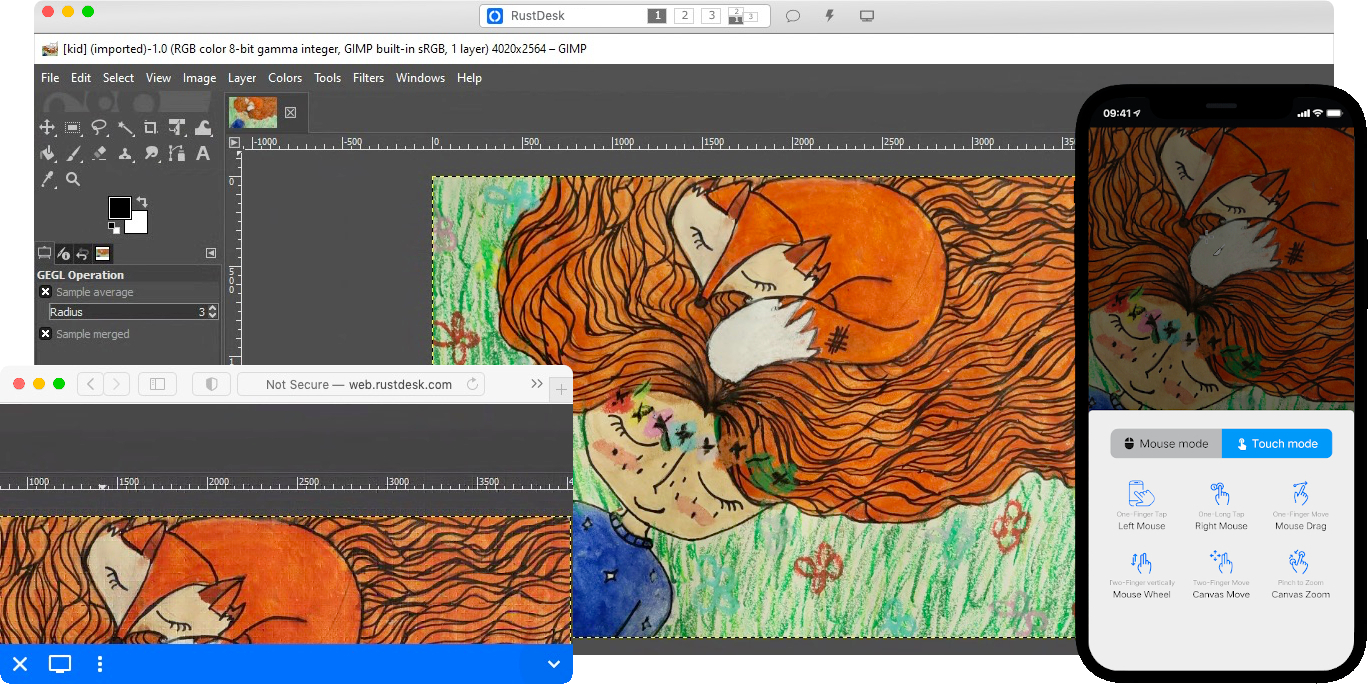
RustDesk welcomes contribution from everyone. See CONTRIBUTING.md for help getting started.

Dependencies
Desktop versions use Flutter or Sciter (deprecated) for GUI. This tutorial is for Sciter only, since it is easier and more friendly to start. Check out our CI for building the Flutter version.
Please download Sciter dynamic library yourself.
Raw Steps to build
-
Prepare your Rust development env and C++ build env
-
Install vcpkg, and set
VCPKG_ROOTenv variable correctly- Windows: vcpkg install libvpx:x64-windows-static libyuv:x64-windows-static opus:x64-windows-static aom:x64-windows-static
- Linux/macOS: vcpkg install libvpx libyuv opus aom
-
run
cargo run
Build
How to Build on Linux
Ubuntu 18 (Debian 10)
sudo apt install -y zip g++ gcc git curl wget nasm yasm libgtk-3-dev clang libxcb-randr0-dev libxdo-dev \
        libxfixes-dev libxcb-shape0-dev libxcb-xfixes0-dev libasound2-dev libpulse-dev cmake make \
        libclang-dev ninja-build libgstreamer1.0-dev libgstreamer-plugins-base1.0-dev
openSUSE Tumbleweed
sudo zypper install gcc-c++ git curl wget nasm yasm gcc gtk3-devel clang libxcb-devel libXfixes-devel cmake alsa-lib-devel gstreamer-devel gstreamer-plugins-base-devel xdotool-devel
Fedora 28 (CentOS 8)
sudo yum -y install gcc-c++ git curl wget nasm yasm gcc gtk3-devel clang libxcb-devel libxdo-devel libXfixes-devel pulseaudio-libs-devel cmake alsa-lib-devel gstreamer1-devel gstreamer1-plugins-base-devel
Arch (Manjaro)
sudo pacman -Syu --needed unzip git cmake gcc curl wget yasm nasm zip make pkg-config clang gtk3 xdotool libxcb libxfixes alsa-lib pipewire
Install vcpkg
git clone https://github.com/microsoft/vcpkg
cd vcpkg
git checkout 2023.04.15
cd ..
vcpkg/bootstrap-vcpkg.sh
export VCPKG_ROOT=$HOME/vcpkg
vcpkg/vcpkg install libvpx libyuv opus aom
Fix libvpx (For Fedora)
cd vcpkg/buildtrees/libvpx/src
cd *
./configure
sed -i 's/CFLAGS+=-I/CFLAGS+=-fPIC -I/g' Makefile
sed -i 's/CXXFLAGS+=-I/CXXFLAGS+=-fPIC -I/g' Makefile
make
cp libvpx.a $HOME/vcpkg/installed/x64-linux/lib/
cd
Build
curl --proto '=https' --tlsv1.2 -sSf https://sh.rustup.rs | sh
source $HOME/.cargo/env
git clone --recurse-submodules https://github.com/rustdesk/rustdesk
cd rustdesk
mkdir -p target/debug
wget https://raw.githubusercontent.com/c-smile/sciter-sdk/master/bin.lnx/x64/libsciter-gtk.so
mv libsciter-gtk.so target/debug
VCPKG_ROOT=$HOME/vcpkg cargo run
How to build with Docker
Begin by cloning the repository and building the Docker container:
git clone https://github.com/rustdesk/rustdesk
cd rustdesk
git submodule update --init --recursive
docker build -t "rustdesk-builder" .
Then, each time you need to build the application, run the following command:
docker run --rm -it -v $PWD:/home/user/rustdesk -v rustdesk-git-cache:/home/user/.cargo/git -v rustdesk-registry-cache:/home/user/.cargo/registry -e PUID="$(id -u)" -e PGID="$(id -g)" rustdesk-builder
Note that the first build may take longer before dependencies are cached, subsequent builds will be faster. Additionally, if you need to specify different arguments to the build command, you may do so at the end of the command in the <OPTIONAL-ARGS> position. For instance, if you wanted to build an optimized release version, you would run the command above followed by --release. The resulting executable will be available in the target folder on your system, and can be run with:
target/debug/rustdesk
Or, if you're running a release executable:
target/release/rustdesk
Please ensure that you run these commands from the root of the RustDesk repository, or the application may not find the required resources. Also note that other cargo subcommands such as install or run are not currently supported via this method as they would install or run the program inside the container instead of the host.
File Structure
- libs/hbb_common: video codec, config, tcp/udp wrapper, and some other utility functions shared with the server
- libs/base: protobuf, fs functions for file transfer, keyboard and platform code used only by this app
- libs/scrap: screen capture
- libs/enigo: platform specific keyboard/mouse control
- libs/clipboard: file copy and paste implementation for Windows, Linux, macOS.
- src/ui: obsolete Sciter UI (deprecated)
- src/server: audio/clipboard/input/video services, and network connections
- src/client.rs: start a peer connection
- src/rendezvous_mediator.rs: Communicate with rustdesk-server, wait for remote direct (TCP hole punching) or relayed connection
- src/platform: platform specific code
- flutter: Flutter code for desktop and mobile