 RustDeskandClaude Opus 5
bac8323e5d
RustDeskandClaude Opus 5
bac8323e5d
* wayland: say which step of the portal handshake failed

The XDG portal handshake is four sequential requests, and every way it can end
badly -- the user declining, the request being dismissed, a timeout, the portal
being absent or dying mid-handshake, the stream list coming back empty -- left
`request_remote_desktop` through one `bail!` carrying one string.
`map_err_scrap` then guessed a cause by looking for "dbus" or "pipewire" in
that string. Since that string always mentions "PipeWire library", a decline
and a three-minute timeout both came out as "Wayland requires higher version of
linux distro. Please try X11 desktop or change your OS." On Ubuntu 21+, where
the mapping passes the text through untouched, they came out as raw English
pointing at an unrelated GitHub issue.

The response code and the D-Bus error were in hand at the moment of failure and
were being dropped: `handle_response` collapsed all of it into one
`AtomicBool`. Record it instead, tagged with the stage that produced it, and
let the app side look the tag up. `map_err_scrap` gains one leading branch;
anything untagged -- which is everything the capture loop reports -- takes the
existing path unchanged.

What the peer is told is chosen from the tag, and only from facts the tag
actually carries:

- A decline and an interaction that ended some other way are separate outcomes
  and say so. The Request spec defines response 1 as the user cancelling, and
  guarantees nothing more about 2 than that it ended -- libportal treats 2 as a
  plain failure -- so 2 says the request ended without completing and does not
  guess who ended it or why.
- A timeout says it timed out. It does not say nobody answered: RustDesk passes
  a saved `restore_token` with `persist_mode` 2, and a restored session is
  exactly the case where the portal shows no picker at all, so there may have
  been no dialog for anyone to answer.
- Not reaching the session bus, a portal that answers but does not implement
  what was called, and a grant that fails only when the PipeWire connection is
  handed over, each get their own message. None of the three is fixed by
  restarting the portal, so none of them is told to. Each says only what its
  evidence supports: failing to open the session bus does not prove nobody is
  logged in, and `UnknownMethod` on RemoteDesktop does not prove the portal
  cannot capture a screen. Which interface was called is in the D-Bus message
  that goes to the log; the message to the peer does not claim one.
- What is left -- the portal absent, silent, or failing mid-handshake -- keeps
  the existing `xdp-portal-unavailable`, which is already translated everywhere
  and carries the one remedy that fits: `systemctl --user restart
  xdg-desktop-portal`.
- The Ubuntu-before-21 branch keeps every outcome that says something about the
  machine and yields the three that say what happened to the request.

Two more say less than they could, for the same reason. `streams_from_response`
comes back empty when the response cannot be parsed as well as when there is
nothing in it, so the message says RustDesk did not obtain a usable screen
rather than that the portal offered none. `ElementFactory::make` fails the same
way for a plugin that is absent as for one that will not load, so the message
says the component could not be loaded rather than that it is missing.

The D-Bus error name and message, the portal response code and the GStreamer
factory's own error go to the log. Only the element name also reaches the peer,
because it is the one detail that says which package to look at.

`fill_displays` needs the tag resolved at its own call site: it opens a second
portal session for cursor-based display disambiguation, and its error returns
straight up `check_init` without passing through `map_err_scrap`, so a tag
would otherwise reach the peer verbatim.

Two existing paths change, both necessarily:

- `check_init` no longer wraps `Capturer::new` in `with_context`. The peer is
  shown `format!("{}", err)` (connection.rs), which renders only the outermost
  layer, so that context was replacing the mapped code with "Failed to create
  capturer for display 0".
- The `std::process::exit(-1)` on libdbus' no-reply text is now reached only by
  the capture loop, which is what that self-heal was written for. Every D-Bus
  call in the handshake -- opening the session bus, `get_request_path`, the
  `add_match` inside `handle_response`, `create_session`, and `conn.process` in
  the wait loop -- carries a tag, so a no-reply there is reported rather than
  fatal. It is worth saying plainly what that branch did before: the portal
  proxy has a one-second timeout, so a portal slow to activate could take the
  whole service down.

Co-Authored-By: Claude Opus 5 <noreply@anthropic.com>
Claude-Session: https://claude.ai/code/session_01EZ49AbZJYfm8NTp5yDPMab

* wayland: lang keys for the staged portal failures

Eight keys, appended to `template.rs` and to every `src/lang/*.rs`. `it.rs`
gets empty values, as AGENTS.md requires -- it is maintained by hand by its
translator. No `en.rs` entries: each key is already its own English display
text, which is also what an older peer falls back to.

One carries a `{}`, the name of the GStreamer element that could not be created
-- the one detail that tells a user which package to look at. `lang.rs`'s
`extract_placeholder` resolves a key by replacing the first `{...}` with `{}`,
which is why the server sends the value still inside the braces and why the
scrap side strips braces out of any detail before it gets there. Everything
else technical stays in the log: a D-Bus error name or a portal response code
in a dialog is noise to the person reading it.

Co-Authored-By: Claude Opus 5 <noreply@anthropic.com>
Claude-Session: https://claude.ai/code/session_01EZ49AbZJYfm8NTp5yDPMab

---------

Co-authored-by: Claude Opus 5 <noreply@anthropic.com>

Build •
Docker •
Structure •
Screenshots
[Українська] | [česky] | [中文] | [Magyar] | [Español] | [فارسی] | [Français] | [Deutsch] | [Polski] | [Indonesian] | [Suomi] | [മലയാളം] | [日本語] | [Nederlands] | [Italiano] | [Русский] | [Português (Brasil)] | [Esperanto] | [한국어] | [العربي] | [Tiếng Việt] | [Dansk] | [Ελληνικά] | [Türkçe] | [Norsk] | [Română]
We need your help to translate this README, RustDesk UI and RustDesk Doc to your native language
Caution
Misuse Disclaimer:
The developers of RustDesk do not condone or support any unethical or illegal use of this software. Misuse, such as unauthorized access, control or invasion of privacy, is strictly against our guidelines. The authors are not responsible for any misuse of the application.
Chat with us: Discord | Twitter | Reddit | YouTube

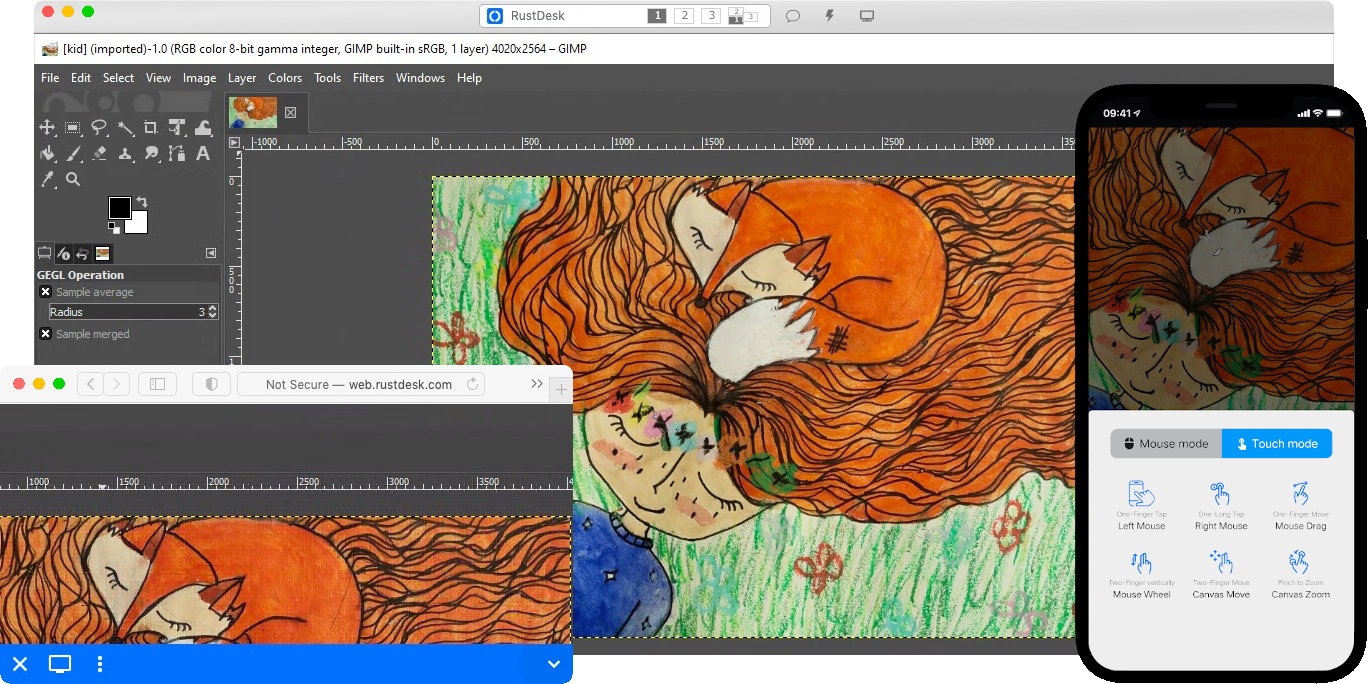
Yet another remote desktop solution, written in Rust. Works out of the box with no configuration required. You have full control of your data, with no concerns about security. You can use our rendezvous/relay server, set up your own, or write your own rendezvous/relay server.
RustDesk welcomes contribution from everyone. See CONTRIBUTING.md for help getting started.

Dependencies
Desktop versions use Flutter or Sciter (deprecated) for GUI. This tutorial is for Sciter only, since it is easier and more friendly to start. Check out our CI for building the Flutter version.
Please download Sciter dynamic library yourself.
Raw Steps to build
-
Prepare your Rust development env and C++ build env
-
Install vcpkg, and set
VCPKG_ROOTenv variable correctly- Windows: vcpkg install libvpx:x64-windows-static libyuv:x64-windows-static opus:x64-windows-static aom:x64-windows-static
- Linux/macOS: vcpkg install libvpx libyuv opus aom
-
run
cargo run
Build
How to Build on Linux
Ubuntu 18 (Debian 10)
sudo apt install -y zip g++ gcc git curl wget nasm yasm libgtk-3-dev clang libxcb-randr0-dev libxdo-dev \
        libxfixes-dev libxcb-shape0-dev libxcb-xfixes0-dev libasound2-dev libpulse-dev cmake make \
        libclang-dev ninja-build libgstreamer1.0-dev libgstreamer-plugins-base1.0-dev
openSUSE Tumbleweed
sudo zypper install gcc-c++ git curl wget nasm yasm gcc gtk3-devel clang libxcb-devel libXfixes-devel cmake alsa-lib-devel gstreamer-devel gstreamer-plugins-base-devel xdotool-devel
Fedora 28 (CentOS 8)
sudo yum -y install gcc-c++ git curl wget nasm yasm gcc gtk3-devel clang libxcb-devel libxdo-devel libXfixes-devel pulseaudio-libs-devel cmake alsa-lib-devel gstreamer1-devel gstreamer1-plugins-base-devel
Arch (Manjaro)
sudo pacman -Syu --needed unzip git cmake gcc curl wget yasm nasm zip make pkg-config clang gtk3 xdotool libxcb libxfixes alsa-lib pipewire
Install vcpkg
git clone https://github.com/microsoft/vcpkg
cd vcpkg
git checkout 2023.04.15
cd ..
vcpkg/bootstrap-vcpkg.sh
export VCPKG_ROOT=$HOME/vcpkg
vcpkg/vcpkg install libvpx libyuv opus aom
Fix libvpx (For Fedora)
cd vcpkg/buildtrees/libvpx/src
cd *
./configure
sed -i 's/CFLAGS+=-I/CFLAGS+=-fPIC -I/g' Makefile
sed -i 's/CXXFLAGS+=-I/CXXFLAGS+=-fPIC -I/g' Makefile
make
cp libvpx.a $HOME/vcpkg/installed/x64-linux/lib/
cd
Build
curl --proto '=https' --tlsv1.2 -sSf https://sh.rustup.rs | sh
source $HOME/.cargo/env
git clone --recurse-submodules https://github.com/rustdesk/rustdesk
cd rustdesk
mkdir -p target/debug
wget https://raw.githubusercontent.com/c-smile/sciter-sdk/master/bin.lnx/x64/libsciter-gtk.so
mv libsciter-gtk.so target/debug
VCPKG_ROOT=$HOME/vcpkg cargo run
How to build with Docker
Begin by cloning the repository and building the Docker container:
git clone https://github.com/rustdesk/rustdesk
cd rustdesk
git submodule update --init --recursive
docker build -t "rustdesk-builder" .
Then, each time you need to build the application, run the following command:
docker run --rm -it -v $PWD:/home/user/rustdesk -v rustdesk-git-cache:/home/user/.cargo/git -v rustdesk-registry-cache:/home/user/.cargo/registry -e PUID="$(id -u)" -e PGID="$(id -g)" rustdesk-builder
Note that the first build may take longer before dependencies are cached, subsequent builds will be faster. Additionally, if you need to specify different arguments to the build command, you may do so at the end of the command in the <OPTIONAL-ARGS> position. For instance, if you wanted to build an optimized release version, you would run the command above followed by --release. The resulting executable will be available in the target folder on your system, and can be run with:
target/debug/rustdesk
Or, if you're running a release executable:
target/release/rustdesk
Please ensure that you run these commands from the root of the RustDesk repository, or the application may not find the required resources. Also note that other cargo subcommands such as install or run are not currently supported via this method as they would install or run the program inside the container instead of the host.
File Structure
- libs/hbb_common: video codec, config, tcp/udp wrapper, and some other utility functions shared with the server
- libs/base: protobuf, fs functions for file transfer, keyboard and platform code used only by this app
- libs/scrap: screen capture
- libs/enigo: platform specific keyboard/mouse control
- libs/clipboard: file copy and paste implementation for Windows, Linux, macOS.
- src/ui: obsolete Sciter UI (deprecated)
- src/server: audio/clipboard/input/video services, and network connections
- src/client.rs: start a peer connection
- src/rendezvous_mediator.rs: Communicate with rustdesk-server, wait for remote direct (TCP hole punching) or relayed connection
- src/platform: platform specific code
- flutter: Flutter code for desktop and mobile